

Choose an option to see quick actions and get help faster.
.svg)
Losing AC After a Grid Spike: Immediate Steps for Orange Homeowners
Did your air conditioner suddenly stop running right after the lights flickered, leaving you wondering exactly who to call for 24/7 emergency HVAC in Orange when the grid spikes? You are not alone. At Airflow Systems, Inc., we know that late-summer heat is unforgiving, especially as families are busy with the back-to-school transition, and losing your cooling system during a sudden afternoon power surge creates immediate stress and discomfort for your entire household.
The core dilemma most homeowners face in this exact moment is figuring out what actually happened. You need to know if the system just needs a simple reset at the electrical panel, or if a vital electrical component was completely destroyed by the sudden influx of voltage. Navigating post-storm air conditioner issues requires a safe, step-by-step assessment to avoid causing further damage to your equipment. Before you panic, there are a few safe steps you can take to check your system. However, if your unit remains unresponsive, you will need to rely on professional air conditioning services and prompt emergency AC repair from our trusted local team to restore your home's comfort safely.
What to Do When Your AC Won't Turn On After a Storm
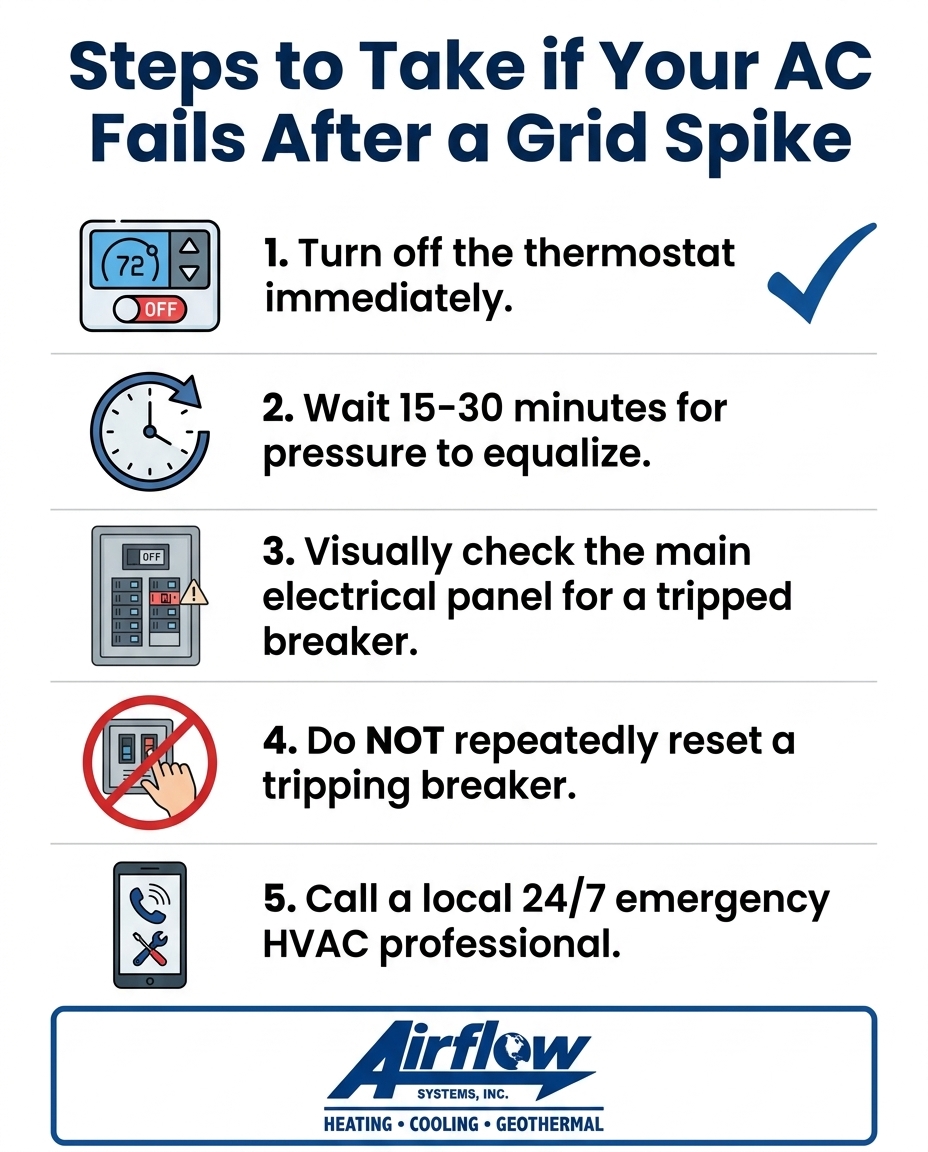
When the power flickers and returns, but your cooling system stays completely silent, your next actions are critical. Taking the wrong steps can turn a minor electrical hiccup into a catastrophic compressor failure. Our team at Airflow Systems, Inc. recommends following this safe, straightforward procedure to assess your equipment without putting yourself or your system at risk.
1. Turn off the thermostat immediately: Drop the system setting from "Cool" to "Off." If a component was damaged during the grid spike, you want to prevent the system from repeatedly trying to cycle on. Forcing a damaged air conditioner to start can permanently fry the compressor motor.
2. Wait 15 to 30 minutes before attempting a restart: Patience is essential here. Your air conditioner operates under high internal refrigerant pressure. When power drops suddenly, that pressure gets locked in place. Waiting allows the internal pressure to equalize so the compressor doesn't have to fight against immense resistance when it tries to start back up.
3. Check the main electrical panel for a tripped breaker: Perform a strictly visual inspection of your home's main breaker box. Look for the dedicated dual-pole breaker labeled for your HVAC system or air conditioner. If the switch has moved to the middle, neutral position, the safety mechanism did its job during the surge.
4. Listen for unusual buzzing or humming noises: Walk outside to your condenser unit. If you hear a loud, continuous humming or buzzing sound but the large fan blade is not spinning, turn the system off immediately. This specific noise strongly indicates a serious electrical fault, usually a failed start component.
5. Leave the system off if it remains unresponsive: If you have waited the appropriate time, confirmed the breaker is in the correct position, and the system still refuses to turn on, stop troubleshooting. Leave the thermostat in the "Off" position and prepare to call a professional technician for a thorough diagnostic.
Why August Thunderstorm Season Is So Hard on HVAC Capacitors
The combination of relentless late-summer heat and sudden afternoon weather shifts creates the perfect environment for electrical failures. In our years servicing Charlottesville, Orange, and Central Virginia, we've noticed that August thunderstorm season brings intense humidity that forces your air conditioner to run almost continuously. When a sudden grid spike hits a system that is already working at maximum capacity, the internal components take a massive hit.
The most vulnerable part of your outdoor unit during these events is the capacitor. You can think of a capacitor as a massive, heavy-duty battery that stores electrical energy. Its primary job is to deliver a powerful, instantaneous jolt of electricity to jump-start the compressor and the fan motor every time the thermostat calls for cooling. Because it is designed to hold and discharge high voltage, it is highly sensitive to sudden fluctuations in incoming power.
When lightning strikes nearby or the utility grid spikes, a massive influx of voltage floods the system. This sudden surge easily overwhelms the capacitor's internal storage limits. The dielectric fluid inside boils, the internal layers short out, and the component effectively "frys." You might even see the top of a damaged capacitor bulging outward like a swollen tin can. Older systems, or units that have been running nonstop through the peak summer heat, are especially susceptible to these sudden voltage changes because their electrical components are already fatigued. Understanding the mechanics behind this vulnerability makes it clear why power surges often lead to capacitor failure during late-summer storms, a pattern our technicians see almost daily this time of year.
Tripped Breaker or Fried System? Safe Checks to Make
After a storm, distinguishing between a tripped safety mechanism and actual component failure is the key to protecting your home. A tripped breaker is simply your electrical panel doing its job—cutting power to prevent wires from overheating. A blown capacitor, however, is a physical hardware failure that requires replacement parts.
Our technicians always remind homeowners that you can safely check your home's main electrical panel to see if the HVAC breaker has tripped. A tripped breaker will not be fully in the "Off" position; instead, it will sit loosely in the middle. To reset it safely, you must firmly push the switch all the way to the "Off" position until it clicks, and then push it firmly back to the "On" position. If the system starts up and runs normally, you likely just experienced a temporary surge.
However, we've seen too many homeowners attempt do-it-yourself electrical work beyond checking the breaker—something you must explicitly avoid. Never open the air conditioner's metal access panel or attempt to touch internal electrical components. Capacitors store lethal amounts of voltage even when the main power is completely turned off. Touching the wrong terminal can result in severe injury.
When to Stop and Call a Pro
There is a hard line between a safe visual check and a dangerous situation. You should immediately stop troubleshooting and call for professional help if you notice any of the following warning signs:
• The breaker trips a second time: If you reset the breaker and it instantly trips again, or trips after a few minutes of operation, do not reset it a third time. This indicates a dead short or a locked compressor pulling massive amounts of electricity. Repeatedly resetting it is a severe fire hazard.
• A burning smell near the vents or outdoor unit: If you detect an acrid, electrical burning odor coming from your supply registers or the outdoor cabinet, a wire or circuit board has likely melted. Leave the system off.
• The outdoor fan won't spin but you hear humming: As mentioned earlier, a loud hum with a stationary fan blade means the motor is trying to pull power but lacks the capacitor's jump-start to get moving. Leaving the power on in this state will quickly burn out the fan motor.
• Breaker is in the middle position — Likely Cause: Temporary power surge — Required Action: Reset once safely; monitor system
• Breaker trips repeatedly — Likely Cause: Electrical short or locked motor — Required Action: Leave off; call for emergency repair
• Loud buzzing at outdoor unit — Likely Cause: Blown run capacitor — Required Action: Turn off thermostat immediately; call pro
• Acrid, electrical burning smell — Likely Cause: Melted wiring or fried board — Required Action: Cut power at breaker; schedule service
Behind the Scenes: How We Triage 24/7 Emergency Calls
When a severe thunderstorm rolls through the Orange area and causes widespread grid spikes, our dispatch center at Airflow Systems, Inc. experiences a sudden, massive flood of phone calls. Dozens of homeowners suddenly find themselves without cooling at the exact same moment. Understanding how local HVAC teams manage this influx can help set your expectations when you need to make that critical phone call.
Unlike national corporate call centers that operate on rigid, opaque scripts, our independent, locally-owned business offers honest, direct communication about wait times and dispatch priority. Our dispatchers use a careful triage process to ensure the most critical situations receive immediate attention. We prioritize calls based on severe safety hazards—such as electrical burning smells or smoking units—and complete system failures in homes with highly vulnerable residents, like the elderly or those with medical conditions.
We see this pattern of sudden demand year-round, and our team is built to handle it. For instance, when one local customer's furnace went down right before the winter holidays, our office staff was highly responsive, communicated clearly, and routed a knowledgeable technician to get the system running quickly before the freeze set in. We apply that exact same urgency, discipline, and transparent triage process during late-summer heat waves. When you reach out from Orange and surrounding service areas, you speak with local dispatchers who understand the regional weather, know the neighborhoods, and work tirelessly to quickly identify and correct AC problems so your comfort is restored efficiently.
Frequently Asked Questions About Post-Storm HVAC Emergencies
Can a power surge ruin an AC unit?
Yes, severe power surges can completely ruin an air conditioning unit by bypassing basic electrical protections. When a massive grid spike hits, the sudden influx of high voltage can instantly melt delicate circuit boards, fuse electrical contacts together, and destroy the compressor motor. Even minor, repetitive surges over time degrade the insulation on internal wiring, significantly shortening the lifespan of your entire HVAC system.
How do I know if my AC capacitor is blown?
The most common sign of a blown AC capacitor is a loud humming sound coming from the outdoor unit while the top fan blade remains completely still. You might also notice warm air blowing from your indoor vents, or hear a repetitive clicking sound coming from the outdoor cabinet as the system tries and fails to start. If you look closely through the top grate, you may even see that the silver, cylindrical capacitor looks swollen or is leaking a thick fluid.
What should I do if my AC won't turn on after a storm?
If your AC won't turn on after a storm, your first step is to turn the thermostat to the "Off" position to prevent further electrical damage. Wait 15 to 30 minutes to allow the refrigerant pressures to equalize, then safely check your main electrical panel for a tripped breaker. If the breaker is not tripped, or if it immediately trips again after a single reset, leave the system off and call for professional diagnostics.
Should I call emergency HVAC for a blown capacitor?
Yes, you should call for emergency HVAC service if you suspect a blown capacitor, because running a system in this state is highly destructive. When the capacitor fails, the compressor and fan motors try to pull massive amounts of electricity to start, which causes them to overheat rapidly. Ignoring a straightforward capacitor replacement today can easily result in needing a major compressor replacement tomorrow.
Will a surge protector prevent HVAC storm damage?
A dedicated HVAC surge protector significantly reduces the risk of grid spike damage by absorbing and redirecting excess voltage before it reaches your equipment. While no device on the market is 100% proof against a direct lightning strike to your home, a high-quality surge protector is incredibly effective against the standard utility grid fluctuations and localized storm spikes that cause the vast majority of electrical component failures.
How long does it take to replace a fried capacitor?
Once a professional technician arrives on-site, a capacitor replacement is typically a very fast repair. Because it is such a common casualty of late-summer storms, the Airflow Systems, Inc. technicians carry a wide variety of capacitors on their trucks. The actual physical replacement, testing the voltage, and verifying the system is cooling properly can often be completed in under an hour.
Restore Your Comfort Safely and Quickly
While grid spikes and sudden afternoon storms are stressful, the resulting air conditioner damage is often a straightforward fix for a highly trained professional. The most important thing you can do is prioritize safety—never repeatedly reset a tripping breaker, and never attempt to handle high-voltage components on your own. If you suspect electrical damage after a storm, do not wait out the stifling heat hoping the system will magically fix itself.
By relying on the transparent, responsive team at Airflow Systems, Inc., you can get your system accurately diagnosed and repaired before the house becomes dangerously hot. Furthermore, staying proactive with a comprehensive preventative maintenance plan ensures that your system's safety components, wiring, and capacitors are regularly tested. Routine check-ups give you the confidence that your equipment is operating correctly and is fully prepared to weather the next inevitable late-summer storm.
Book Expert Service Or Contact Us
Our Service Process
A Hassle-Free Service Experience
01
Consultation & Diagnosis
We start by listening to your needs and performing a thorough diagnosis of your system to recommend the best solution.
02
Transparent Quoting
We provide a clear, upfront estimate with no hidden fees, so you know exactly what to expect.
03
Expert Service & Follow-Up
Our factory-trained technicians complete the work to the highest standards, and we follow up to ensure your complete satisfaction.
testimonials
What Our Customers Are Saying
Our customers consistently praise our exceptional service and attention to detail, making us a trusted choice for all your HVAC needs.
where we operate
Service areas