

Choose an option to see quick actions and get help faster.
.svg)
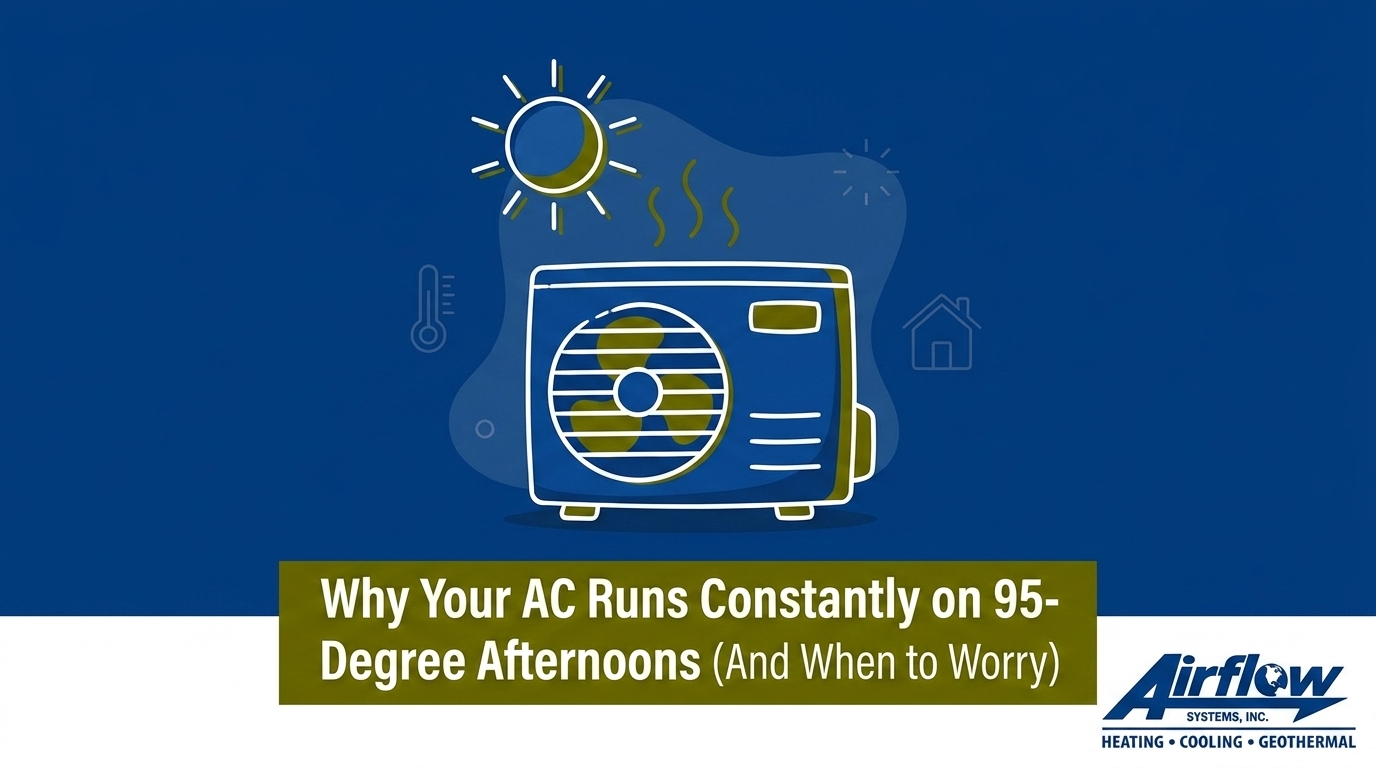
Is It Normal for an AC to Run Non-Stop During Extreme Summer Heat?
Are you wondering why your AC runs constantly on 95-degree afternoons (and when to worry) instead of cycling off like it normally does during milder weather? When the thermostat holds steady but the compressor outside simply will not shut down, it is easy to assume your system is failing. Here at Airflow Systems, Inc., our team fields countless calls from panicked Charlottesville homeowners during peak July heatwaves. Before you reach for the phone to book an emergency repair, you face a critical decision: figure out if your system is actually malfunctioning, or if it is just doing exactly what it was engineered to do under a heavy load.
For immediate assistance with your home's cooling, explore our air conditioning systems or schedule professional AC repair today.
Hearing an air conditioner run for three, four, or even five hours straight during peak summer extreme heat often leads to unnecessary homeowner panic. Most people are conditioned to hear their cooling system turn on, run for fifteen minutes, and turn off. While that short cycling behavior is standard for a mild 80-degree spring day, extreme heat changes the rules of mechanical cooling.
Modern air conditioning systems are precisely calibrated devices designed to operate under maximum load conditions. When the temperature outside spikes, a properly sized unit will shift to a 100% duty cycle. This means continuous operation is often the ultimate proof of correct system sizing, not a defect. A system that runs non-stop but successfully maintains your indoor temperature is a system working at peak design capacity.
Understanding HVAC Design Temperatures and the 1% Rule
To understand why your cooling system behaves differently during a heatwave, you have to look at how residential HVAC systems are engineered. Equipment is not sized by guessing or by measuring the square footage of a house alone. Industry professionals use ACCA Manual J calculations to determine exact heating and cooling loads based on local average high temperatures, known as "design temperatures."
Systems are purposefully not engineered for the absolute hottest day of the decade. Instead, they are built around the ASHRAE 1% cooling design temperature rule. Here is how that calculation breaks down in practical terms:
• The 8,760-Hour Year: There are 8,760 hours in a standard year.
• The 1% Threshold: The 1% design temperature represents the temperature that the local climate will exceed for only 1% of the hours in a year (roughly 88 hours).
• The Regional Baseline: For many mid-Atlantic regions, this 1% design temperature sits right around 91 to 93 degrees Fahrenheit.
When you face a 95-degree ambient temperature, the weather has officially exceeded the system's design baseline. At this threshold, a properly sized compressor will run at nearly a 100% duty cycle. The system is no longer trying to rapidly cool the house down; it is deploying all of its capacity just to maintain the current indoor temperature against the overwhelming heat pushing against your exterior walls. It is doing exactly what it was engineered to do.
The Hidden Burden of High Humidity on Cooling Systems
Temperature is only half of the equation when it comes to indoor comfort. Air conditioners are tasked with removing two distinct types of heat from your home: sensible heat and latent heat. Understanding the difference between the two explains why run times stretch so long during the worst parts of the summer.
Sensible Heat vs. Latent Heat
Sensible heat is the actual temperature reading you see on your thermostat—the thermal energy you can feel. Latent heat, on the other hand, is the moisture or humidity trapped in the indoor air. An air conditioner cannot effectively lower the sensible heat until it has successfully removed the latent heat.
In our years of experience servicing homes across Charlottesville, we've seen firsthand how hot, highly humid summers create a massive latent heat load inside the home. When the air is thick with moisture, the air conditioner's evaporator coil must run continuously to pull that water vapor out of the air and drain it away. If the system were to shut off quickly, it would leave the house feeling cold but uncomfortably clammy.
Longer run times are actually necessary and highly beneficial for proper dehumidification. The longer the air washes over the cold indoor coil, the more moisture is extracted. If your home struggles with excessive moisture, looking into home energy efficiency can help identify where humid outside air is infiltrating your thermal envelope during peak summer extreme heat.
Why a Continuously Running AC is Better Than an Oversized Unit
A common misconception among homeowners is that a bigger, faster-cooling air conditioning unit is inherently better. If a massive unit can cool a house down in ten minutes on a 95-degree ambient temperature day, it must be superior, right? The short answer is no. Oversized systems introduce a host of mechanical and comfort problems.
When an oversized unit blasts cold air and satisfies the thermostat rapidly, it experiences "short-cycling." The system turns on, runs for a brief period, shuts off, and then turns right back on a few minutes later as the heat seeps back in. This rapid starting and stopping requires massive surges of electricity and causes excessive wear and tear on the compressor.
• Humidity Control — Oversized AC System (Short-Cycling): Poor. Shuts off before moisture is removed. — Properly Sized AC System (Continuous Run): Excellent. Long cycles extract maximum humidity.
• Temperature Balance — Oversized AC System (Short-Cycling): Uneven. Creates hot and cold spots in the house. — Properly Sized AC System (Continuous Run): Consistent. Steady airflow mixes the air evenly.
• Energy Efficiency — Oversized AC System (Short-Cycling): Low. Startup power surges waste electricity. — Properly Sized AC System (Continuous Run): High. Cruising at a steady speed uses less power.
• Equipment Lifespan — Oversized AC System (Short-Cycling): Reduced. Constant starting stresses the compressor. — Properly Sized AC System (Continuous Run): Maximized. Designed for extended duty cycles.
Continuous running under heavy load is the hallmark of accurate ACCA Manual J sizing. A properly sized unit running constantly uses energy much more efficiently than an oversized unit constantly turning on and off, much like a car getting better gas mileage on the highway than in stop-and-go city traffic.
When to Worry About Your AC Running Constantly
While continuous operation during severe heat is normal, there are secondary symptoms that indicate an actual malfunction. Our technicians at Airflow Systems focus on transparent education about normal extreme-heat operation rather than using continuous running as a scare tactic to push unnecessary repairs. In fact, a pattern we see often is perfectly healthy systems being flagged by worried homeowners simply because they are working hard. You should only be concerned if the non-stop running is accompanied by specific warning signs.
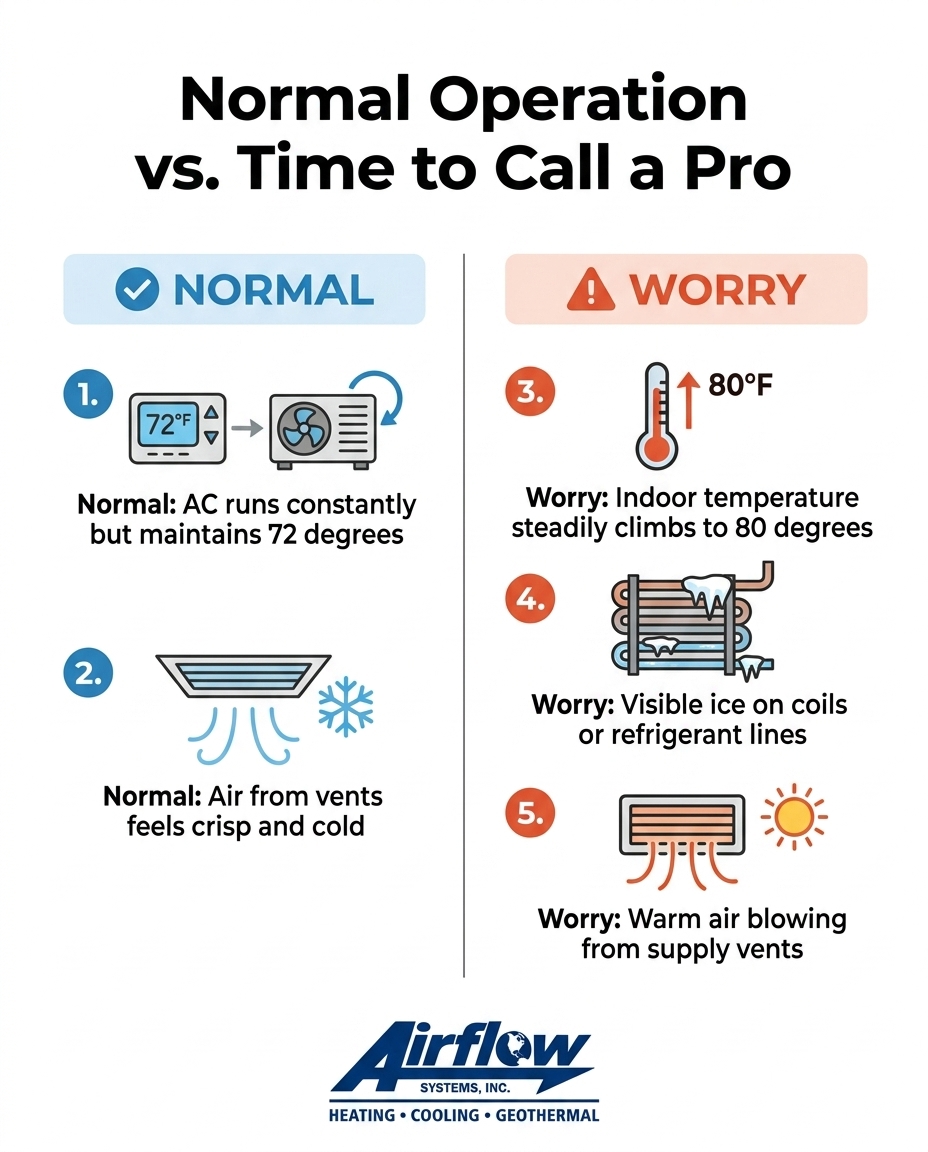
Look for these symptoms to determine if your system is failing:
• The indoor temperature is steadily rising: If your thermostat is set to 72 degrees, but the indoor temperature climbs to 78 or 80 degrees while the system runs, the equipment is losing ground.
• Warm air from supply registers: The air blowing out of your vents should feel crisp and cold. If it feels lukewarm or room-temperature, the cooling process has stopped.
• Visible ice buildup: Check the indoor evaporator coil and the copper refrigerant lines at the outdoor unit. Ice indicates restricted airflow or a refrigerant leak.
• Unusual mechanical noises: A steady hum is normal. Grinding, squealing, or violent rattling noises while running continuously indicate failing components.
• High humidity levels indoors: If the house feels like a swamp despite the system running constantly, the evaporator coil may not be draining properly.
Educating yourself on how to verify these signs helps you avoid panic-booking unnecessary service calls. If you spot any of these red flags during a 95-degree ambient temperature event, reviewing what to check if your AC is not cooling properly is your best next step.
Troubleshooting Steps Before Booking a Service Call
If your system is running non-stop and struggling to hold the temperature, there are a few immediate actions you can take to give the equipment its best chance of keeping up before calling a professional.
1. Check and replace dirty air filters: Our team typically sees clogged filters as the number one culprit behind restricted airflow. The blower motor has to work twice as hard to pull air through a wall of dust, which drastically reduces the system's cooling capacity and forces it to run even longer.
2. Ensure all indoor supply and return vents are open: Walk through every room and verify that no vents are blocked by heavy furniture, rugs, or curtains. Closing vents in unused rooms actually disrupts the system's pressure balance and makes it work harder.
3. Verify the thermostat setting: Set a reasonable temperature for extreme heat. Trying to force a system to maintain 68 degrees on a 98-degree day will guarantee non-stop running and eventual freezing. A setpoint of 72 to 74 degrees is much more achievable.
4. Reduce solar heat gain: Keep blinds, shades, and curtains closed on sun-facing windows during the hottest parts of the day. Blocking direct sunlight prevents the greenhouse effect from adding unnecessary thermal load to your home.
Staying on top of these basic checks, along with scheduling routine AC maintenance, ensures your system is optimized to handle peak summer extreme heat without unnecessary strain.
Frequently Asked Questions About AC Performance in Extreme Heat
Is it normal for AC to run constantly in hot weather?
Yes, if the ambient temperature exceeds the system's design temperature, continuous operation is completely normal. As long as the indoor temperature matches the thermostat setpoint, the equipment is functioning exactly as engineered. The system runs non-stop because the heat entering your home equals the amount of heat the air conditioner is capable of removing.
How long should AC run on a 90 degree day?
Run times vary based on insulation and humidity, but cycles of 45 minutes to over an hour are common on a 90-degree day. During peak afternoon heat, it may not cycle off at all until the sun sets. The heavier the latent heat load (humidity) in the house, the longer the system will run to extract that moisture before satisfying the thermostat.
Will my AC break if it runs all day?
No, modern compressors are designed for continuous duty cycles and will not break simply from running all day. Starting and stopping (short-cycling) actually causes significantly more wear and tear on electrical components than cruising continuously. Think of it like highway driving versus city driving; the steady pace is far gentler on the machinery.
Why can't my AC keep up on a 95 degree day?
The system may be sized for a lower maximum temperature, typically around a 92-degree design baseline. When temperatures spike beyond this engineered limit, the AC will run constantly but may allow the indoor temperature to drift up slightly. This drift is a mathematical reality of HVAC sizing, not necessarily a mechanical failure.
How do I know if my AC is struggling or just working hard?
A hard-working AC maintains the setpoint and blows crisp, cold air from the registers. A struggling AC blows warm air, allows the indoor temperature to steadily climb away from the setpoint, or shows physical signs of distress like freezing coils. Verifying the temperature of the air at the vent is the easiest way to tell the difference.
Keep Your Cooling System Reliable Through the Hottest Afternoons
Understanding HVAC design temperatures brings immense peace of mind during extreme heat events. Knowing the critical difference between a hard-working system operating at peak capacity and a broken system actively failing saves you from unnecessary panic. If your equipment is running constantly but holding the line on your thermostat during peak summer extreme heat, you can rest easy knowing it is doing its job.
However, if you have checked the vents and noticed actual warning signs—like warm air blowing, climbing indoor temperatures, or visible ice on the coils—it is time to act. Do not let a minor mechanical issue turn into a total compressor failure. Schedule professional AC repair with our dedicated Airflow Systems team before the next severe heatwave hits to ensure your home stays comfortable and protected all season long.
Book Expert Service Or Contact Us
Our Service Process
A Hassle-Free Service Experience
01
Consultation & Diagnosis
We start by listening to your needs and performing a thorough diagnosis of your system to recommend the best solution.
02
Transparent Quoting
We provide a clear, upfront estimate with no hidden fees, so you know exactly what to expect.
03
Expert Service & Follow-Up
Our factory-trained technicians complete the work to the highest standards, and we follow up to ensure your complete satisfaction.
testimonials
What Our Customers Are Saying
Our customers consistently praise our exceptional service and attention to detail, making us a trusted choice for all your HVAC needs.
where we operate
Service areas