

Choose an option to see quick actions and get help faster.
.svg)
The Predictable August Breakdown: When Your AC Finally Gives Out
Before the first autumn breeze arrives and the back-to-school transition begins, homeowners facing a sudden late-summer breakdown are forced to confront the wear-and-tear reality of running an undersized AC unit. Late summer in Central Virginia brings a special kind of relentless heat, and losing your indoor cooling during the hottest part of the year is more than just inconvenient—it is physically exhausting. The thermostat climbs, the air grows stagnant, and the immediate frustration sets in as you realize the system you have relied on for months has simply given up.
Here is the thing: August cooling failures are rarely sudden, random flukes. At Airflow Systems, Inc., our team consistently sees that they are almost always the predictable, cumulative result of an undersized system that has been forced to operate without adequate rest cycles. When an air conditioning unit lacks the proper cooling capacity for the square footage and thermal load of a home, it has to work continuously to try and reach the set temperature. This relentless operation leads directly to a critical decision point: deciding whether to endlessly patch up worn-out, degraded components or to replace the equipment entirely with a properly sized system that can actually handle the seasonal load.
If you are currently dealing with a system failure and need immediate relief, exploring professional air conditioning services or scheduling emergency AC repair is the first step toward restoring comfort.
The 60-Day Stress Test: Running at 100% Capacity
To understand why an undersized unit breaks down at the end of the summer, you have to look at the mechanical expectations of residential cooling equipment. An air conditioning system is fundamentally designed to cycle on, extract heat from the indoor air, reach the thermostat's set point, and then cycle off to rest. This off-cycle is critical for allowing the compressor motor to cool down and for internal pressures to equalize.
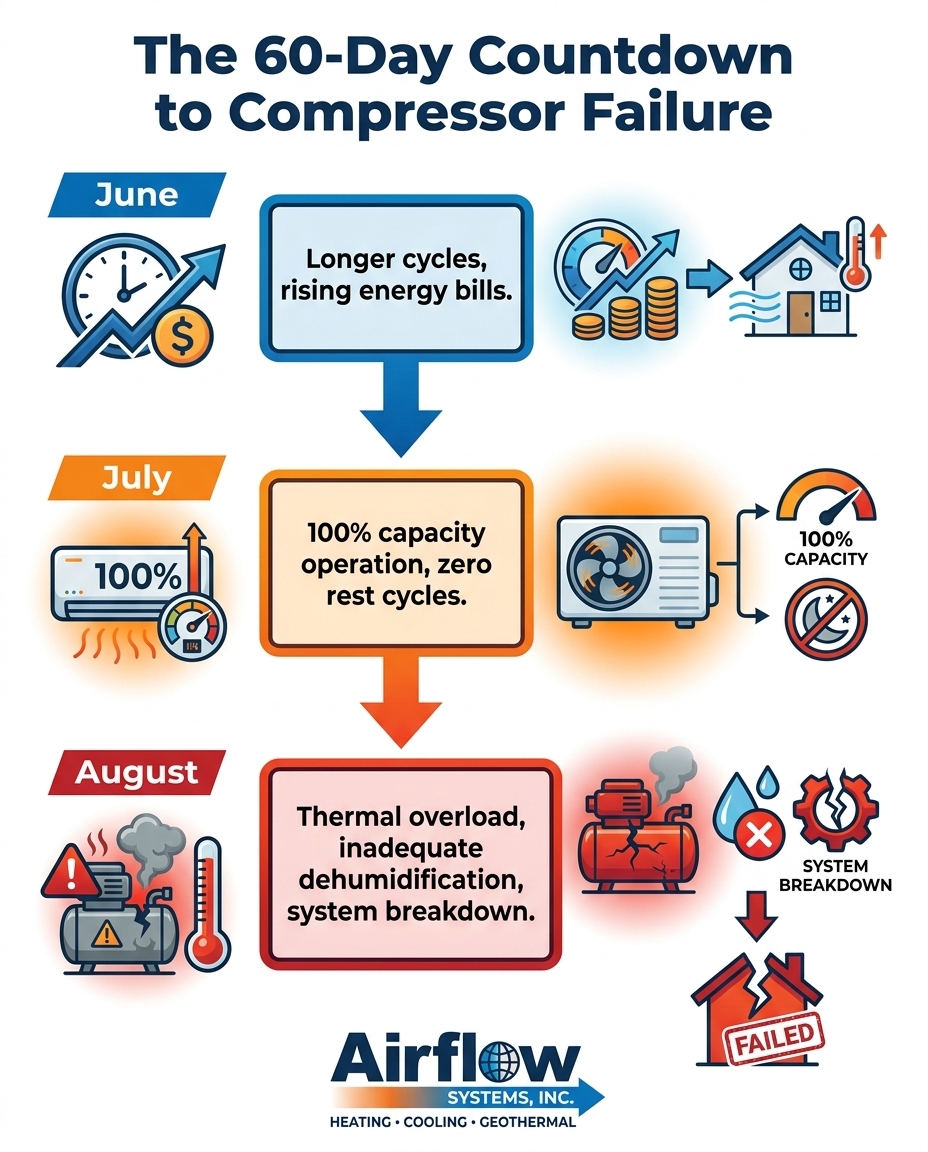
An undersized unit is denied this necessary recovery time. Because it lacks the raw cooling capacity to overcome the heat transferring into the house, it is forced to run continuously. By the time late August arrives, the system has effectively been subjected to a grueling stress test, often running at 100% capacity for 60 straight days. This timeline of mechanical wear follows a very predictable pattern that our technicians observe year after year.
June: The Initial Strain
As early summer heat sets in, the system begins running noticeably longer cycles. At this stage, the undersized unit can usually still keep the house relatively comfortable, especially during the cooler morning and evening hours. However, the first warning signs appear in the form of elevated energy consumption. The unit is working harder than it should, but because the indoor temperature still feels acceptable, the underlying sizing issue goes largely ignored.
July: Continuous Operation
When the intense mid-summer heat waves strike, the unit stops cycling off entirely during the afternoon and early evening. The thermostat might be set to 72 degrees, but the indoor temperature hovers stubbornly at 76 degrees. During this phase, internal components begin operating outside of their intended thermal limits. Motors run hotter, electrical contactors endure sustained electrical loads, and the compressor is deprived of its critical cooling periods.
August: The Breaking Point
After weeks of zero rest, the cumulative degradation reaches its peak. Operating at 100% capacity for 60 straight days finally takes its toll on the weakened components. Bearings seize, capacitors bulge and fail, or the compressor motor completely burns out. The homeowner is left with a sudden loss of end-of-season cooling, but from our mechanical standpoint in the field, the breakdown was entirely predictable.
Battling Piedmont Humidity: The Latent Heat Factor
The strain on an undersized unit is magnified significantly by the regional climate. Our technicians at Airflow Systems, Inc. know firsthand that Charlottesville's hot, highly humid Piedmont weather demands peak performance from an air conditioner, forcing it to manage two entirely different types of cooling simultaneously. Understanding this dual workload is key to understanding why undersized systems fail so frequently in our specific area during late summer.
Air conditioners must handle both sensible cooling and latent cooling. Sensible cooling is the process of lowering the actual temperature of the air—the number you see on the thermostat. Latent cooling is the process of extracting moisture from the air, which reduces humidity and makes the home feel comfortable rather than sticky.
• Sensible Cooling — Primary Function: Lowers the indoor air temperature (thermostat reading). — Impact of an Undersized Unit: Runs continuously but fails to drop the temperature during peak afternoon heat.
• Latent Cooling — Primary Function: Removes airborne moisture (humidity). — Impact of an Undersized Unit: Lacks the sustained coil capacity to extract enough water, leaving the home feeling clammy.
High summer humidity forces the AC to work double duty. Because an undersized unit lacks the sustained capacity to extract enough moisture, the indoor air remains saturated. Even if the unit never stops running, the home feels clammy, warm, and distinctly uncomfortable by the time late August arrives. The system is expending massive amounts of energy trying to condense water vapor, leaving very little capacity left over to actually lower the room temperature.
Compressor Burnout: The Mechanical Cost of No Rest Cycles
The heart of any air conditioning system is the compressor. Located in the outdoor condenser unit, the compressor is responsible for pumping refrigerant through the lines, facilitating the heat transfer process that keeps your home cool. It is also the most expensive component in the system and the primary victim of continuous operation.
Compressors are cooled by the very refrigerant they pump, but they still require off-cycles to shed excess heat. When an undersized system runs at 100% capacity for 60 straight days, the lack of off-cycles prevents the compressor from cooling down. This leads to thermal overload. The internal windings of the motor break down, the lubricating oil degrades, and eventually, the compressor suffers a catastrophic electrical or mechanical failure.
Beyond the compressor, continuous operation triggers a cascade of secondary failures across the system:
• Frozen Evaporator Coils: When a system runs non-stop, minor airflow restrictions (like a slightly dirty filter) are magnified. The indoor coil drops below freezing, turning airborne condensation into a solid block of ice that completely blocks airflow.
• Burnt Contactors: The electrical relays that send power to the compressor and fan motors pit and burn from sustaining heavy electrical loads for hours on end without a break.
• Failed Blower Motors: The indoor fan motor, forced to push air continuously against static pressure, overheats and fails prematurely.
Most homeowners do not realize the severity of the situation until the system stops blowing cold air. However, a pattern we see often in the field is that constant AC running signals a problem long before the final breakdown occurs. Ignoring a system that never shuts off is essentially waiting for the compressor to burn itself out.
The Trap of the Emergency 'Like-for-Like' Swap
When an August breakdown happens, the panic of sitting in a sweltering house often drives rushed decisions. The immediate temptation is to accept the fastest possible replacement option just to get the cold air flowing again. Frequently, this means allowing a contractor to perform an emergency "like-for-like" swap—replacing the broken three-ton unit with a brand new three-ton unit.
Assuming the previous installer sized the unit correctly is a costly mistake. Homes change over time. Windows are upgraded, insulation settles, ductwork develops leaks, and sometimes, the original unit was simply undersized from the day it was installed. A fast-swap tactic, often used by high-volume national chains during the peak of late-summer emergencies, completely ignores the root cause of the failure.
There is immense value in working with honest, independent Central Virginia HVAC experts—like our dedicated team at Airflow Systems, Inc.—who take the time to do proper calculations, even in an emergency. An unverified "like-for-like" swap simply resets the clock for another wear-and-tear failure in the future. You are putting a brand new engine into a car that is too heavy for it to pull; it will run for a while, but it will eventually burn out just like the last one.
Manual J Load Calculations: The Definitive Sizing Solution
When a critical system goes down at the worst possible moment—much like when one local homeowner's furnace failed right before the winter holidays and our technician Shannon Crickenberger had to step in to get it running quickly—the natural response is to rush the replacement. But rushing skips the most critical step in preventing future failures: accurately determining the home's thermal load.
The only definitive way to escape the cycle of excessive wear and tear is to ensure the new system is precisely matched to the home's requirements. This is achieved through a Manual J load calculation. Recognized as the industry standard by the Air Conditioning Contractors of America (ACCA), a Manual J calculation is a mathematical assessment of exactly how much heating and cooling a specific home requires.
A proper calculation considers a wide array of factors rather than just guessing based on square footage:
• Insulation Levels: The R-value of the insulation in the attic, walls, and crawlspace.
• Window Placement: The size, type, and orientation of windows, accounting for afternoon solar heat gain.
• Regional Climate: The specific temperature and humidity extremes of the local area.
• Ductwork Integrity: The condition and layout of the existing air distribution system.
• Occupancy: The number of people living in the home, as bodies generate heat and moisture.
Proper sizing is not an upsell; it is a mechanical necessity. If you want a system that can handle running at 100% capacity for 60 straight days without destroying itself, the only way to guarantee accurate sizing is through a professional HVAC replacement process that prioritizes long-term comfort over rushed band-aids.
Deciding Between Late-Summer Repairs and a Proper Replacement
Once the diagnosis is confirmed by our technicians and you are staring down a major repair bill in late summer, the decision matrix becomes critical. Do you replace the burned-out compressor, or do you invest in a properly sized new system?
Replacing a compressor on an undersized unit is often a losing battle. You are installing a brand new, expensive component into a system that is still fundamentally too small for the house. The new compressor will immediately be subjected to the exact same continuous running conditions that killed the original one. Furthermore, the ongoing energy costs of running an undersized unit continuously will continue to drain your wallet month after month.
• Repairing the Undersized Unit — Short-Term Impact: Restores cooling temporarily; lower immediate out-of-pocket cost. — Long-Term Reality: High monthly energy bills continue; the new parts will inevitably fail from continuous overwork.
• Properly Sized Replacement — Short-Term Impact: Requires a larger upfront investment and a brief installation window. — Long-Term Reality: System cycles normally, humidity is controlled, energy usage drops, and mechanical lifespan is maximized.
When considering a replacement, keep in mind that generic federal tax credits or local utility incentive programs may apply to qualifying high-efficiency AC or heat pump installations. We always advise checking with your utility provider or a tax professional to verify current programs that can help offset the investment. While routine HVAC maintenance can help monitor the rate of degradation and keep coils clean to maximize airflow, no amount of maintenance can fix a fundamental sizing issue. If the unit is too small, it will run until it breaks. Investing in a properly sized system eliminates the root cause of the stress.
Frequently Asked Questions About Undersized AC Systems
Why is my AC running constantly in late summer?
In late summer, cumulative heat and humidity peak, placing maximum demand on your cooling system. An undersized unit lacks the raw capacity to cool the home efficiently under these extreme conditions. Because it cannot extract enough heat to reach the thermostat's set point, it is forced to run continuously without ever cycling off to rest.
What happens to the compressor when an AC is undersized?
The compressor is denied necessary rest cycles when the system runs non-stop. This relentless operation leads to severe thermal overload, as the motor cannot shed the heat it generates. Over time, this causes accelerated mechanical wear, degraded lubrication, and eventual complete compressor burnout.
Can an undersized AC cause high electric bills?
Yes. Because an undersized unit never cycles off during the hottest parts of the day, it draws maximum electrical power continuously. This lack of efficiency and constant energy consumption leads to significant spikes in your monthly utility costs, far exceeding what a properly sized unit would use.
Will an undersized AC cool the house?
It may cool the house adequately during mild spring weather when the thermal load is low. However, during peak summer heat, an undersized unit will fail to maintain comfortable indoor temperatures. Furthermore, it will struggle to remove sufficient humidity, leaving the home feeling warm and clammy.
How do I know what size AC my home actually needs?
The only accurate method for determining the correct size is a Manual J load calculation performed by a qualified HVAC professional. Guessing based on square footage alone is an outdated practice that frequently leads to undersizing or oversizing. A proper calculation accounts for insulation, windows, climate, and ductwork.
Escape the Cycle of Late-Summer AC Failures
Dealing with an August breakdown is stressful, especially with the back-to-school transition underway, but it also presents an opportunity to fix the problem permanently. The relief of having a properly sized system is immediate: the house cools down quickly, the humidity drops, the unit cycles off as it should, and you no longer have to listen to the condenser running continuously outside your window.
If your system has failed, or if it has been running non-stop just to keep the house marginally comfortable, now is the time to schedule an honest professional evaluation. By determining if your current breakdown is due to undersizing, you can make an informed decision rather than throwing good money at a doomed system. For immediate assistance and an expert assessment of your equipment, reach out to our experienced team at Airflow Systems, Inc. for professional AC repair today.
Book Expert Service Or Contact Us
Our Service Process
A Hassle-Free Service Experience
01
Consultation & Diagnosis
We start by listening to your needs and performing a thorough diagnosis of your system to recommend the best solution.
02
Transparent Quoting
We provide a clear, upfront estimate with no hidden fees, so you know exactly what to expect.
03
Expert Service & Follow-Up
Our factory-trained technicians complete the work to the highest standards, and we follow up to ensure your complete satisfaction.
testimonials
What Our Customers Are Saying
Our customers consistently praise our exceptional service and attention to detail, making us a trusted choice for all your HVAC needs.
where we operate
Service areas