

Choose an option to see quick actions and get help faster.
.svg)

What It Really Means When Your AC Keeps Tripping the Breaker
AC circuit breaker keeps tripping what it means is one of the most common — and most stressful — electrical questions homeowners in Charlottesville, VA face during the heat of summer. If your air conditioner shuts off and you keep walking to your electrical panel to reset the same breaker, your system is sending you a clear warning: something is pulling more power than it should.
The good news is that a tripping breaker is actually doing its job. It is a built-in safety device that cuts power before overheating, damaged wiring, or worse — an electrical fire — can occur. The bad news is that the cause could range from something simple like a dirty air filter to something more serious like a failing compressor or an electrical short.
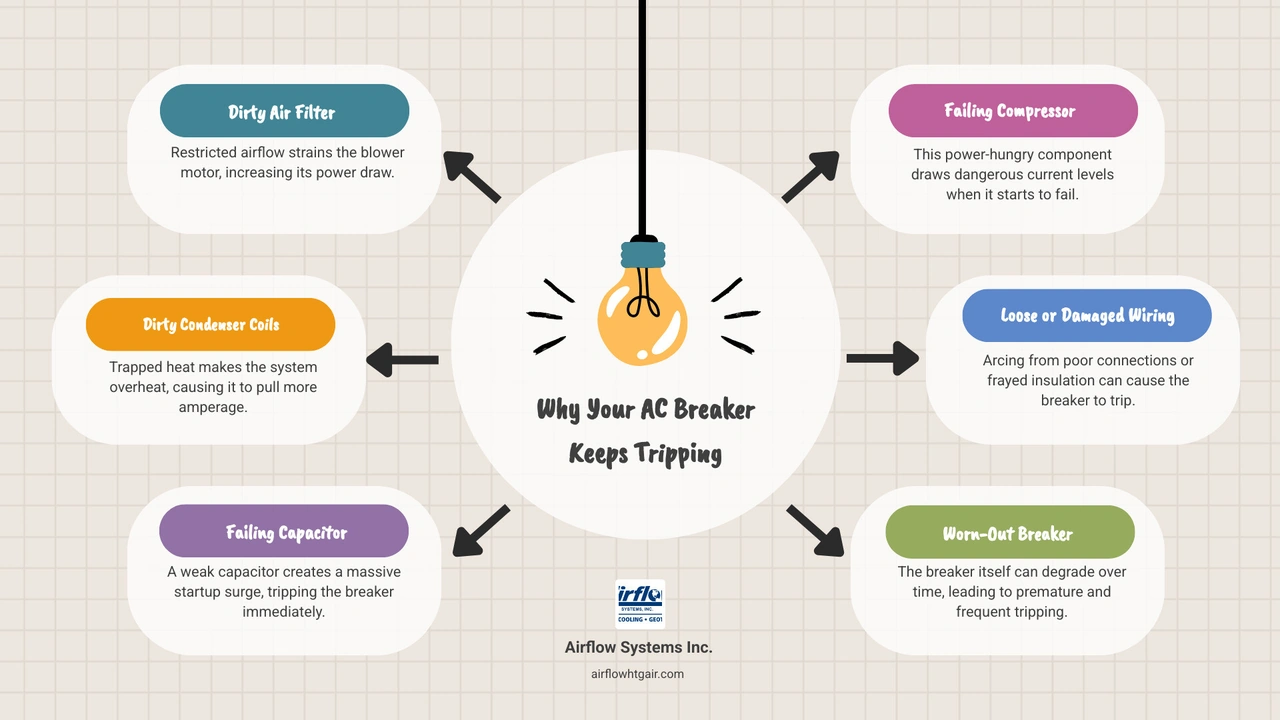
Here is a quick summary of the most common reasons your AC breaker keeps tripping:
• Dirty air filter — restricted airflow forces the blower motor to work harder and draw excess current
• Dirty condenser coils — trapped heat causes the system to overheat and pull more amps
• Failing capacitor — a weak capacitor causes a massive startup surge that immediately trips the breaker
• Failing or grounded compressor — the most power-hungry component in your AC draws dangerous levels of current when it starts to fail
• Loose or damaged wiring — arcing from loose connections or frayed wire insulation can trip the breaker even when the AC unit itself seems fine
• Worn-out breaker — the breaker itself can weaken over time and trip too easily
• Outdoor fan motor failure — without proper airflow over the condenser, the system overheats rapidly
• Low refrigerant — a refrigerant leak forces the system to work harder, increasing electrical load
What you should not do is keep resetting the breaker and hoping the problem goes away. Repeated resets without fixing the underlying cause can degrade wire insulation and significantly increase the risk of an electrical fire.
In this guide, Airflow Systems Inc. walks you through what each of these causes means for your system, what you can safely check yourself, and when it is time to call a professional.
Understanding Your AC Circuit Breaker and Why It Is Important
Think of your circuit breaker as the "smoke alarm" for your home's electrical system. It is a safety switch designed to monitor the flow of electricity to your air conditioner. Under normal circumstances, electricity flows steadily to power your cooling system. However, if the current exceeds the safe limit—meaning the AC is drawing more amperage than the circuit is rated for—the breaker "trips" or snaps to the "off" position.
This overcurrent protection is vital for electrical fire prevention. Without a breaker, an overloaded wire would simply continue to heat up until the insulation melts and the surrounding materials ignite. Because your air conditioner is one of the most power-hungry appliances in your Charlottesville home, it usually sits on a dedicated circuit. This means the breaker is sized specifically for the high amperage ratings of your AC unit and shouldn't be shared with other appliances.
If your system is making odd sounds before the power cuts out, you might find our guide on AC Making Strange Noises? What They Mean helpful in identifying the mechanical root of the electrical surge.
Common Reasons an AC Circuit Breaker Keeps Tripping What It Means for Your System
When we look at why ac circuit breaker keeps tripping what it means for your daily comfort, we usually find a handful of common culprits. Most of these involve the system working much harder than it was ever designed to.
1. Dirty Air Filters and Restricted Airflow
A clogged air filter is the most common reason for a "nuisance trip." Imagine trying to breathe with a pillow over your face—that is what your blower motor feels like when a filter is caked in dust. To compensate for the restricted airflow, the motor has to spin faster and work harder, which spikes the electricity draw. This can eventually lead to the motor overheating and tripping the breaker. If you've noticed your home isn't getting as cold as it used to, check out our tips on AC Not Cooling Properly? What to Check First.
2. Dirty Condenser Coils
Your outdoor unit (the condenser) is responsible for releasing the heat collected from inside your home. If the coils are covered in dirt, grass clippings, or spider webs, they act as an insulator, trapping heat inside. This prevents efficient heat dissipation, causing the compressor to run at higher temperatures and pull more power. You can learn How to Clean Your AC Condenser Unit Safely to prevent this specific issue.
3. Outdoor Fan Motor Failure
The fan in your outdoor unit pulls air through the coils to cool the refrigerant. If the motor fails or the blades are obstructed, the refrigerant won't cool down. This leads to a rapid pressure buildup inside the system, forcing the compressor to work against extreme resistance until the electrical load becomes too high for the breaker to handle.
• Airflow Issue — Symptom: Trips after 20-30 minutes of running — Likely Cause: Dirty filter or coils
• Mechanical Failure — Symptom: Trips immediately upon startup — Likely Cause: Bad capacitor or grounded compressor
• Electrical Fault — Symptom: Trips randomly, even when AC isn't running — Likely Cause: Loose wiring or faulty breaker
Electrical Faults and AC Circuit Breaker Keeps Tripping What It Means for Safety
Sometimes the problem isn't mechanical strain, but a direct electrical failure. These are often more dangerous and require immediate professional attention.
• Ground Faults: Statistics show that ground faults make up 98% of all electrical faults. This occurs when electricity "leaks" out of its intended path and touches a grounded part of the system (like the metal casing). This creates an immediate surge that should trip the breaker instantly.
• Short Circuits: A short circuit happens when two hot wires touch each other or a neutral wire. This usually results from damaged wire insulation—often caused by rodents or simple wear and tear over the years.
• Loose Electrical Connections: The vibrations from your AC unit can, over time, loosen the screws holding the wires in place at the breaker or the unit's contactor. Loose connections create resistance, which generates heat and "arcing." Modern breakers are very sensitive to this and will trip to prevent a fire.
Component Failure and AC Circuit Breaker Keeps Tripping What It Means for Your Compressor
The compressor is the heart of your AC system, and it is also the most expensive part to replace. If your breaker trips the exact moment the outdoor unit tries to kick on, the compressor or its supporting parts are likely to blame.
Failed Start Capacitor
The capacitor is like a high-energy battery that gives your motors a "shove" to get them spinning. If the start capacitor fails, the motor will hum but won't turn. This creates a "Locked Rotor Amps" situation where the motor draws a massive startup surge of electricity—sometimes 5 to 6 times its normal operating current—which snaps the breaker open immediately.
Grounded Compressor
A grounded compressor (or a "short to ground") is a critical failure. This happens when the electrical windings inside the compressor motor break down and hit the side of the metal housing. This can ignite the oil inside the compressor and is a major fire hazard. If you suspect this is happening, read more on How to Tell If Your AC Compressor Is Failing and keep the power off.
Troubleshooting Steps for Homeowners in Central Virginia
If you find yourself in April 2026 dealing with a stubborn breaker in Charlottesville, there are a few safe steps you can take before calling us for a service visit.
1. The "One-Reset" Protocol: You should only attempt to reset your breaker once. If it trips a second time, stop. There is a persistent fault that needs a professional eye.
2. Check the Thermostat: Ensure your thermostat is set to "Cool" and the temperature is lower than the current room temp. Sometimes a "glitchy" thermostat can cause the system to cycle on and off too rapidly (short-cycling), which stresses the breaker.
3. Inspect the Air Filter: Pull out your filter. If you can't see light through it, replace it immediately.
4. Clear the Outdoor Unit: Ensure there are at least two feet of clear space around your outdoor condenser. Remove any leaves, tall grass, or debris that might be blocking airflow.
5. Visual Inspection: Without opening any electrical panels, look at the wires leading into your outdoor unit. Do you see any frayed insulation or chew marks?
6. The "Sniff" Test: Go to your electrical panel. Do you smell anything like burnt plastic or ozone? If so, do not touch the breaker and call an electrician or HVAC pro immediately.
When to Call a Professional for AC Electrical Issues
Electrical work is not a DIY project. The voltages required to run an AC unit are high enough to be fatal if mishandled. You should call Airflow Systems Inc. if:
• The breaker trips immediately: If you flip the switch and it pops back to the middle or "off" position within seconds, you likely have a short circuit or a grounded compressor.
• You see smoke or smell burning: This is an emergency. Turn off the power at the main switch if it is safe to do so and call for 24/7 emergency service.
• You hear buzzing or humming: A loud humming sound from the outdoor unit without the fan spinning usually points to a failed capacitor.
• Your lights flicker: If your indoor lights dim significantly every time the AC tries to start, your system is drawing too much current, or your electrical panel is overloaded.
Our technicians use specialized tools like megohmmeters and ammeters to safely test the "amp draw" of your motors and find the exact location of electrical leaks.
Frequently Asked Questions
Is it safe to repeatedly reset a tripping AC breaker?
No, it is absolutely not safe. Every time a breaker trips, it is preventing a potential fire. By forcing it to reset repeatedly, you are forcing high-voltage electricity through a faulted circuit. This degrades the wire insulation and can eventually lead to a fire behind your walls or inside the AC unit. We recommend the "one-reset" rule: try it once, and if it fails, call a pro.
Can a dirty air filter really cause my breaker to trip?
Yes! It is one of the leading causes of blower motor failure. In 2026, modern high-efficiency AC units are designed with very tight tolerances. Even a small amount of airflow restriction can cause the motor to overheat. Regular maintenance is the best way to prevent this simple but frustrating problem.
How can I prevent my AC breaker from tripping in the future?
The best defense is a good offense. Annual maintenance tune-ups allow us to catch loose wires, weak capacitors, and dirty coils before they cause a system-wide shutdown. Given the high humidity we often face in Central Virginia, keeping your outdoor unit clear of organic debris is also vital for long-term reliability.
Conclusion
Understanding ac circuit breaker keeps tripping what it means is the first step toward restoring comfort to your home. Whether it's a simple filter change or a more complex compressor issue, your safety should always come first.
At Airflow Systems Inc., we’ve been serving the Charlottesville, VA community since 1988. As a family-owned and operated business, we pride ourselves on honest diagnostics and reliable repairs. We understand how vital air conditioning is during a Virginia summer, and we are here to help you navigate these electrical headaches with expert care.
If your breaker is giving you trouble, don't stay in the heat. Schedule your professional air conditioning service today and let our certified technicians get your system running safely and efficiently again.
Book Expert Service Or Contact Us
Our Service Process
A Hassle-Free Service Experience
01
Consultation & Diagnosis
We start by listening to your needs and performing a thorough diagnosis of your system to recommend the best solution.
02
Transparent Quoting
We provide a clear, upfront estimate with no hidden fees, so you know exactly what to expect.
03
Expert Service & Follow-Up
Our factory-trained technicians complete the work to the highest standards, and we follow up to ensure your complete satisfaction.
testimonials
What Our Customers Are Saying
Our customers consistently praise our exceptional service and attention to detail, making us a trusted choice for all your HVAC needs.
where we operate
Service areas