


Choose an option to see quick actions and get help faster.
.svg)
Replacing Your Aging HVAC: The Sizing Dilemma
Your old heating system is struggling to keep up, and as you prepare for the September pre-heating season, you are likely wondering how we size a new heat pump using Manual J calculations to ensure lasting comfort. A typical pattern we see is homeowners assuming their new equipment should be the exact same size as their old unit. It feels like the safest, most logical choice. However, guessing the required tonnage or relying on outdated historical data often leads to a system that short-cycles, wastes energy, and leaves your home feeling uncomfortable.
To prevent these frustrating issues, a professional load calculation is the only way to guarantee optimal performance from your new equipment. If you are exploring heat pump systems for your upcoming home upgrade, understanding how this sizing process works is the first step toward lasting efficiency and lower utility bills.
The problem with guessing: Many contractors will simply look at the nameplate on your existing outdoor unit and order a new one with the identical capacity. This approach completely ignores any changes made to your home over the years, from new windows to better attic insulation. When you invest in modern, high-efficiency equipment, precision matters. Without exact measurements, you risk paying for a system that is either too weak to heat your home or too powerful to dehumidify it properly.
The Hidden Risks of a 'Like-for-Like' Tonnage Swap
The most common mistake in the HVAC industry is the "like-for-like" tonnage swap. This happens when a contractor skips the measuring process entirely, assumes the original builders got the sizing right decades ago, and simply installs a new unit of the same size. The hidden risk here is that your home's thermal envelope has likely changed significantly since that original system was put in.
Over the years, older homes often receive incremental upgrades. You might have added blown-in insulation to the attic, replaced drafty single-pane windows with double-pane glass, or sealed up leaky doors. Every single one of these efficiency improvements actually reduces the required heating and cooling load of your house. If your home holds onto conditioned air better today than it did twenty years ago, installing the same massive heat pump will result in an oversized system.
One local homeowner reached out to us with a 30-plus-year-old system they wanted to upgrade. They had many questions and needed patient guidance on converting from an outdated oil setup to a modern dual fuel system. By taking the time to properly measure the home rather than just swapping the old tonnage, we designed a solution that left their indoor climate better than ever, completely eliminating their need for the supplemental cooling units they used to rely on.
Contractors who skip these measurements and quote "like-for-like" sizes are taking a lazy approach that directly risks your investment. The Department of Energy actively warns against oversized heat pumps, noting that they suffer from reduced efficiency, poor moisture control, and premature mechanical failure. Taking detailed Manual J thermal envelope measurements during your heat pump installation planning phase is the only way to protect your home.
• Windows — Original Condition (Decades Ago): Single-pane, drafty frames — Modern Upgrades: Double-pane, argon gas filled — Impact on HVAC Load: Drastically lowers required cooling and heating capacity
• Insulation — Original Condition (Decades Ago): Settled, thin fiberglass batts — Modern Upgrades: Blown-in cellulose or spray foam — Impact on HVAC Load: Traps conditioned air, requiring a smaller heat pump
• Air Sealing — Original Condition (Decades Ago): Gaps around doors and baseboards — Modern Upgrades: Weatherstripping and caulking — Impact on HVAC Load: Reduces draft-related heat loss in winter
What Is a Manual J Calculation?
You might hear technicians throw around the term "Manual J" when discussing your new system, but what does that actually mean? A Manual J calculation is the national industry standard protocol developed by the Air Conditioning Contractors of America (ACCA) for determining the exact heating and cooling loads of residential buildings.
The math behind the comfort: Instead of guessing based on the square footage of your home, this engineering-based approach calculates the precise amount of thermal energy your specific house needs to stay comfortable year-round. It factors in the unique characteristics of your property, generating a data-driven blueprint for your HVAC design.
• It replaces outdated rules of thumb: Relying on square footage alone (e.g., "one ton of capacity for every 500 square feet") is wildly inaccurate because it ignores ceiling height, sun exposure, and building materials.
• It dictates exact equipment sizing: The calculation tells the technician exactly how many BTUs (British Thermal Units) are required to heat and cool the space under extreme weather conditions.
• It is a required design step: Taking accurate Manual J thermal envelope measurements is not an optional, premium upgrade. It is a fundamental requirement for proper system design and long-term reliability.
When a professional uses this standard, they remove all the guesswork. You get a system tailored specifically to the physics of your home, ensuring that every dollar you spend on energy goes directly toward maintaining your ideal indoor temperature.
The Danger of Oversized Units During Virginia's Fall Transition
Proper sizing becomes critically important when you look at our specific regional climate. The Charlottesville September pre-heating season transition is notoriously tricky to manage. During these mild but highly humid transition months, temperatures might only reach the mid-70s, but the air feels heavy and damp. This is exactly when an oversized heat pump will fail you.
Here is the mechanical problem: an oversized unit suffers from a condition called "short-cycling." Because the unit is too powerful for the home's actual thermal load, it turns on, blasts the house with a massive volume of conditioned air, quickly satisfies the thermostat's temperature setting, and shuts off after just five or ten minutes.
The cold and clammy effect: Air conditioning and heat pump systems perform two jobs simultaneously in cooling mode: they lower the temperature (sensible cooling) and they remove moisture from the air (latent cooling). However, the indoor coils need to run continuously for about 15 to 20 minutes before they get cold enough to start effectively pulling humidity out of the air. When an oversized unit short-cycles, it shuts off long before the dehumidification process can happen. The result is a home that feels cold, damp, and incredibly uncomfortable.
Beyond the comfort issues, this constant starting and stopping destroys the equipment. While the wear-and-tear of running an undersized unit is a well-known problem, an oversized unit suffers a similar fate. The compressor takes the most electrical and mechanical stress during startup. A system that cycles on and off 40 times a day will burn out its internal components years faster than a properly sized system that runs in long, smooth, efficient cycles.
How We Measure Your Home's Thermal Envelope
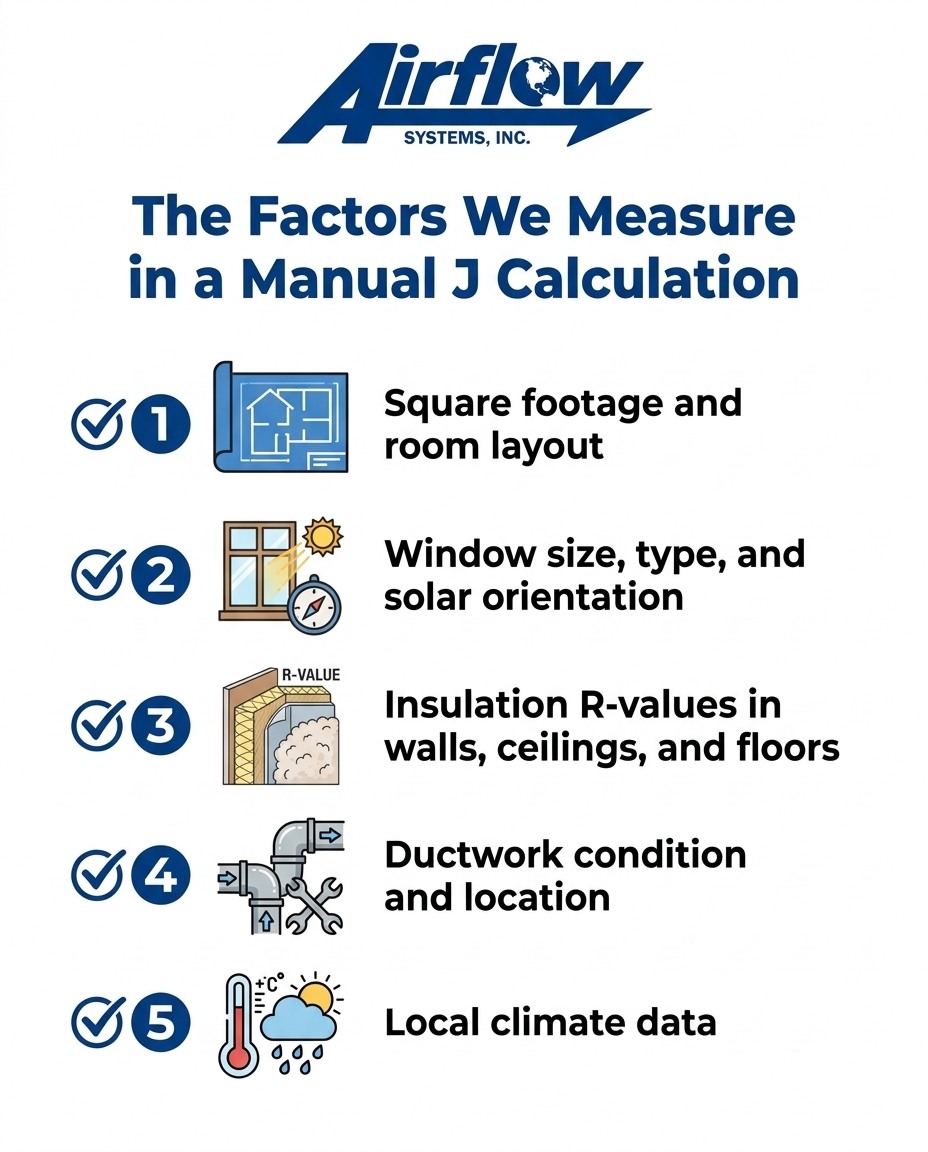
Accurate calculations require a licensed professional to assess your property in person. You cannot perform a true Manual J calculation over the phone or by simply looking at a floor plan. Our technicians spend time walking through your home, inside and out, to gather the detailed data points required by the ACCA software.
1. Measuring physical dimensions: We measure the exact length, width, and ceiling height of every room to calculate the total volume of air that needs to be conditioned.
2. Evaluating construction materials: We note the type of exterior siding, the color of your roof, and whether your home sits on a concrete slab, a crawlspace, or a finished basement.
3. Mapping the ductwork: We inspect where your existing ducts run. Ductwork located in an unconditioned attic loses more thermal energy than ductwork running through a climate-controlled basement.
4. Counting occupants and appliances: People and heat-generating appliances (like ovens and large electronics) add to the internal thermal load of the home, which must be factored into the final math.
Assessing Insulation and Air Leaks
One of the most critical steps in taking Manual J thermal envelope measurements is evaluating the R-value of your existing insulation. We inspect the attic, walls, and floors to determine how well your home resists heat transfer. We also look for significant air leaks or drafts around doors, baseboards, and plumbing penetrations, as these gaps heavily impact your home's ability to hold onto conditioned air.
Evaluating Windows and Sun Exposure
Windows are the weakest point in any home's thermal defense. We measure the total square footage of glass in your home, noting whether the windows are single or double-pane. Just as importantly, we map the solar orientation. A large bay window facing west will let in a massive amount of solar heat during the late afternoon, requiring more cooling power for that specific zone.
Precision Engineering vs. Contractor Guesswork
The difference between a rushed, 15-minute estimate and a thorough, data-driven home assessment is massive. Many contractors prefer the fast route because measuring windows, checking attic insulation, and mapping sun exposure takes time and effort. However, at Airflow Systems, our detailed, engineering-based approach to Manual J calculations serves as a mark of professional expertise and strict accountability.
Protecting your comfort and wallet: We frame the Manual J calculation as a protective measure for your long-term comfort and utility costs. When a contractor guesses your equipment size, they are gambling with your money. If they guess wrong, you are the one left paying high energy bills and dealing with a clammy living room.
Taking the time to measure the thermal envelope proves a commitment to getting the job right the first time. Doing the math upfront prevents expensive comfort issues down the road. It ensures that the heat pump you purchase is perfectly matched to the unique physics of your home, delivering quiet, consistent, and highly efficient temperature control.
Connecting Heat Pump Sizing to Overall Home Efficiency
Proper equipment sizing is just one piece of a much larger puzzle. The Manual J calculation often reveals broader truths about your home's overall energy efficiency. If the math shows that your home requires a surprisingly massive heat pump just to keep up with the winter cold, the smartest financial move might not be buying a bigger unit.
Instead, if a home is highly inefficient, upgrading the insulation or sealing leaky ductwork first can allow you to install a smaller, more affordable heat pump. Comprehensive efficiency evaluations identify exactly where your expensive conditioned air is being wasted. By addressing the building envelope first, you reduce the required thermal load, which saves you money on both the equipment purchase and your monthly energy bills.
We see the incredible results of this holistic approach every winter. During a stretch of minus 5-degree weather, one local family with an inefficient old oil heat and AC system decided it was time for a change. After a proper evaluation, we installed a new dual fuel AC/Heat Pump and gas furnace system tailored to their home. Today, their home comfort is incredibly consistent year-round, and their electric bills have been cut by almost half.
Matching a properly sized unit with a well-sealed home is the ultimate key to long-term utility savings. If you want to understand exactly how your home loses energy before investing in new equipment, exploring home energy audits can provide the roadmap you need for a fully optimized living space.
Frequently Asked Questions
Is a Manual J calculation required for a new heat pump?
Yes, it is the industry standard and often required by local building codes and manufacturer warranties. Skipping this calculation means guessing the size of the equipment, which frequently leads to poor performance and higher energy bills. A professional load calculation ensures your new heat pump is perfectly matched to your home's specific thermal needs.
What happens if my heat pump is oversized?
An oversized heat pump will short-cycle, meaning it turns on and off far too quickly. This rapid cycling prevents the system from running long enough to remove humidity from the air, leaving your home feeling cold and clammy. Additionally, the constant starting and stopping puts immense mechanical strain on the compressor, leading to premature breakdowns.
Why shouldn't I just replace my heat pump with the same size?
Replacing your unit with the exact same size assumes your home's thermal envelope hasn't changed since the original installation. If you have added new windows, better insulation, or sealed air leaks over the years, your home now requires less heating and cooling power. A "like-for-like" swap often results in installing an oversized, inefficient system.
Can I do my own Manual J calculation?
While there are simplified calculators online, a true Manual J calculation requires professional software and the trained eye of a licensed HVAC technician. A professional knows exactly how to evaluate insulation R-values, measure ductwork efficiency, and account for complex solar orientations. Relying on a DIY estimate can lead to costly sizing mistakes.
How long does a proper HVAC load calculation take?
A thorough in-home assessment typically takes a technician anywhere from 45 minutes to an hour and a half, depending on the size and complexity of your house. The technician must measure every room, inspect the attic and crawlspace, and evaluate all windows. Once the data is gathered, it is entered into specialized software to generate the final sizing report.
Does a Manual J calculation account for future home additions?
The calculation is based strictly on the current, measurable physical state of your home at the time of the assessment. If you are actively planning an addition or a major renovation, you must inform your HVAC technician so they can factor the proposed blueprints into the math. Otherwise, the new heat pump will only be sized for your existing layout.
Ready to Upgrade Your Home Comfort?
Replacing your aging equipment doesn't have to mean guessing and hoping for the best. By requiring a proper Manual J load calculation, you ensure your new system will run efficiently, maintain perfect humidity levels, and provide reliable comfort all winter long. Schedule your pre-heating season evaluation today to get the precise, data-driven installation your home deserves.
Book Expert Service Or Contact Us
Our Service Process
A Hassle-Free Service Experience
01
Consultation & Diagnosis
We start by listening to your needs and performing a thorough diagnosis of your system to recommend the best solution.
02
Transparent Quoting
We provide a clear, upfront estimate with no hidden fees, so you know exactly what to expect.
03
Expert Service & Follow-Up
Our factory-trained technicians complete the work to the highest standards, and we follow up to ensure your complete satisfaction.
testimonials
What Our Customers Are Saying
Our customers consistently praise our exceptional service and attention to detail, making us a trusted choice for all your HVAC needs.
where we operate
Service areas