


Choose an option to see quick actions and get help faster.
.svg)
Why Understanding How an AC Tune Up Prevents Costly Summer Breakdowns Could Save You This Season
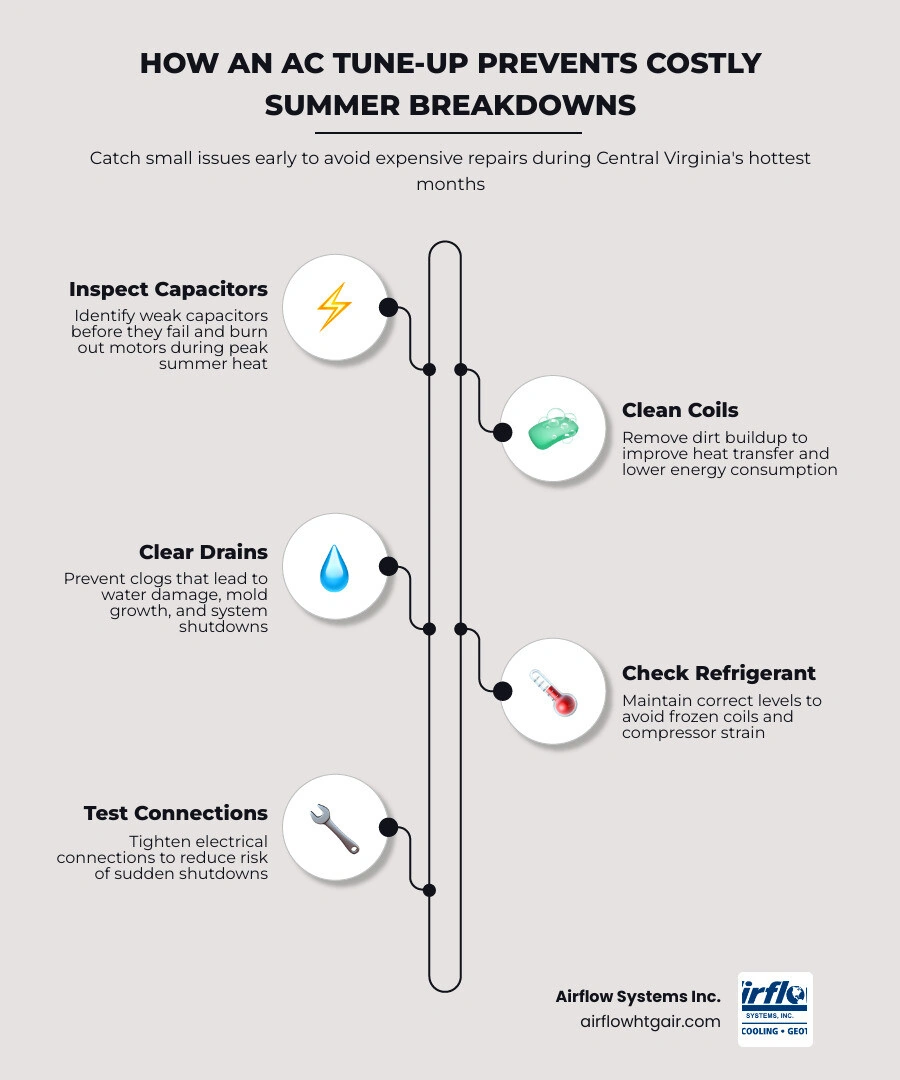
How an AC tune up prevents costly summer breakdowns comes down to one straightforward idea: catching small problems before they become expensive emergencies — especially in Central Virginia's hot, humid summers.
Here's a quick look at how a professional tune-up keeps your system running when you need it most:
• Catches failing capacitors before they cause motor burnout on the hottest day of the year
• Cleans dirty coils that force your system to work harder and use more energy
• Clears clogged condensate drains that can lead to water damage and mold
• Checks refrigerant levels to prevent frozen coils and compressor strain
• Tests electrical connections to reduce the risk of sudden shutdowns
• Calibrates your thermostat so your system isn't running longer than it needs to
• Optimizes airflow to protect your blower motor and keep every room comfortable
Your air conditioner rarely fails on a mild spring day. It fails during the first stretch of 95°F heat in July — the exact week when every HVAC company in Charlottesville is fully booked. According to industry data, up to 80% of costly HVAC repairs trace directly back to skipped routine maintenance. That means most summer breakdowns are not bad luck. They are predictable, and they are preventable.
At Airflow Systems Heating & Air, we've been helping Central Virginia homeowners stay ahead of summer heat since 1988. Scheduling a professional AC tune-up in spring is the single most reliable step you can take to protect your family's comfort, your system's lifespan, and your household budget.
Basic how an ac tune up prevents costly summer breakdowns terms:
• ac tune up guide for central virginia homeowners
• best time of year to schedule your ac tune up
How an AC Tune Up Prevents Costly Summer Breakdowns
When the humidity rolls off the Blue Ridge Mountains and settles into the Charlottesville area, your air conditioning system becomes the most important appliance in your home. Yet, many homeowners treat their cooling systems with an "out of sight, out of mind" mentality. After sitting completely dormant all winter, your AC is suddenly expected to run for hours on end to keep your indoor spaces livable.
This sudden shift from zero activity to maximum effort places tremendous mechanical strain on your system. If there are minor issues lurking within the unit — such as a slightly worn electrical part, a tiny refrigerant leak, or a thin layer of winter dust on the coils — the high-demand environment of a Virginia summer will rapidly expose them.
By scheduling a professional tune-up, you shift from a reactive approach to a proactive one. Proactive maintenance is all about identifying and resolving minor wear and tear before it triggers a complete system shutdown. If you are wondering about the current state of your system, checking for Signs Your AC Needs Repair Before Summer is a great starting point.
Taking the time to understand How to Prepare Your AC for Summer allows you to make informed decisions that keep your family cool and comfortable. Investing in a seasonal tune-up ensures that your system has the mechanical integrity required to handle the hottest days of the year without skipping a beat.
The Anatomy of a Professional Cooling Inspection
A professional cooling tune-up is not a simple, five-minute visual inspection. It is a highly technical, multi-point diagnostic process that requires specialized tools, precise measurements, and a deep understanding of thermodynamics and electrical systems.
To help you understand what goes on behind the scenes, let's break down the core components of a comprehensive cooling inspection. For a detailed roadmap of this process, you can refer to our guide on Spring AC Tune-Up: What to Expect. Additionally, local residents can check out our specialized AC Tune-Up Guide for Central Virginia Homeowners to see how regional climate factors shape our maintenance process.
During a standard visit, our NATE-certified technicians focus on three major systems within your air conditioner: the electrical controls, the thermodynamic cooling cycle, and the physical airflow assembly.
Testing Electrical Components to Prevent Sudden Failures
Your air conditioner relies on a complex network of electrical components to coordinate its operations. When one of these parts begins to degrade, it can cause the entire system to stop working instantly.
• The Run Capacitor: Think of the capacitor as a temporary storage battery that delivers the high-voltage "kick" your compressor and fan motors need to start up and run smoothly. Over time, heat and electrical stress cause capacitors to lose their storage capacity (measured in microfarads). If a capacitor degrades to less than 70% of its rated value, the motor it supports will struggle to start, overheat, and eventually burn out.
• The Contactor: This is the physical switch that opens and closes to send power to the compressor and condenser fan. Every time your system cycles on, a small spark occurs across the contactor's metal points. Over years of service, this sparking causes pitting, carbon buildup, and wear. If the contacts stick together or become too corroded to conduct electricity, your system may run continuously or fail to turn on entirely.
• Wiring and Terminals: The constant vibration of the outdoor unit, combined with seasonal temperature swings, can gradually loosen electrical connections. Loose connections create electrical resistance, which generates heat. This heat can melt wire insulation, damage control boards, and cause safety switches to trip.
If you ever find yourself facing a system that refuses to start up on a hot afternoon, our AC Not Turning On: Complete Guide offers practical troubleshooting steps to help you identify the root cause.
Cleaning Coils and Optimizing Airflow
For your air conditioner to cool your home, it must efficiently transfer heat from your indoor air to the outdoors. This process relies entirely on two clean, unobstructed metal coils: the indoor evaporator coil and the outdoor condenser coil.
• The Condenser Coil: Located in the outdoor unit, this coil is exposed to pollen, grass clippings, dirt, and falling leaves. When a layer of grime builds up on the aluminum fins, it acts as an insulating blanket. Instead of releasing heat into the outdoor air, the heat is trapped inside the system. This forces the compressor to run at higher temperatures and pressures, drastically increasing energy consumption. In fact, dirty condenser coils alone can increase energy consumption by up to 30%.
• The Evaporator Coil: Located inside your home, this coil absorbs heat from your indoor air. If your air filter is dirty or fits poorly, dust and pet dander will bypass it and settle on the cold, damp surface of the evaporator coil. This dust barrier restricts heat transfer, which can cause the refrigerant inside the coil to drop below freezing, turning the condensation on the coil into solid ice.
Keeping these coils clean is paramount. If you want to tackle some basic exterior cleaning yourself, you can learn How to Clean Your AC Condenser Unit Safely without damaging the delicate aluminum fins.
Why Neglecting Spring Maintenance Leads to Summer Disasters
Skipping your annual spring tune-up sets off a slow-motion chain reaction of mechanical wear. While your system might seem to run fine during the mild days of May, the underlying stress of neglected components will eventually lead to a major system failure when the summer heat peaks.
As mechanical friction, electrical degradation, and airflow restrictions compound, they place immense strain on the heart of your air conditioner: the compressor. When a compressor fails, it is often a catastrophic event. To understand the warning signs of serious equipment degradation, take a look at these AC Repair Red Flags That Mean You Need a New System.
How an AC Tune Up Prevents Costly Summer Breakdowns by Catching Weak Capacitors
The relationship between a weak capacitor and a failing compressor is one of the most common "failure cascades" in residential HVAC systems.
When a capacitor's microfarad output drops below its safe operating threshold, it can no longer provide the steady, clean electrical phase shift that the compressor motor requires. As a result, the compressor experiences "hard starting." It will stutter, draw excessive electrical current, and run much hotter than designed.
Over time, this electrical resistance degrades the internal motor windings of the compressor. If left unaddressed, the compressor will eventually suffer a short-to-ground failure, destroying the motor entirely.
Because the compressor is a sealed, highly complex component, replacing it is incredibly labor-intensive. If you suspect your system's core component is struggling, you can read about How to Tell If Your AC Compressor Is Failing. In many cases, especially with older units, you will find that How Compressor Replacement Often Means Full System Replacement is the most practical and cost-effective path forward. A simple capacitor replacement during a spring tune-up completely prevents this entire, multi-thousand-dollar disaster.
How an AC Tune Up Prevents Costly Summer Breakdowns through Airflow Optimization
Airflow is the lifeblood of your air conditioning system. When airflow is restricted by dirty blower wheels, clogged filters, or crushed ductwork, it alters the fundamental physics of the refrigeration cycle.
Without a steady volume of warm indoor air blowing across the indoor evaporator coil, the liquid refrigerant inside the coil cannot absorb enough heat to boil into a vapor. The temperature of the coil drops below 32°F, causing the moisture in the air to freeze solid on the metal fins.
Once a layer of ice forms, it blocks all remaining airflow. This can cause liquid refrigerant to flood back down the suction line into the outdoor compressor. Because compressors are designed to compress gas, not liquid, this "liquid slugging" can instantly destroy the compressor's internal pistons or scroll plates.
If your system is running but failing to lower the temperature in your home, our guide on Why Is My AC Blowing Warm Air? Troubleshooting Steps can help you diagnose whether a frozen coil or restricted airflow is the culprit.
Measurable Efficiency Gains and Long-Term Savings
Investing in preventative maintenance isn't just about avoiding emergency repair bills; it also has a direct, positive impact on your monthly household expenses. A well-maintained system runs shorter, more efficient cycles, which keeps your utility bills under control.
According to the U.S. Department of Energy, proper annual maintenance can reduce your cooling costs by 5% to 15%. Conversely, a neglected system can easily drive energy bills 15% to 25% higher than necessary as it struggles to cool your home. Over a long, hot Virginia summer, those monthly savings quickly add up, easily offsetting the modest cost of a professional tune-up.
Furthermore, regular maintenance preserves your system's efficiency rating (SEER2). A high-efficiency system can quickly degrade to the performance level of a standard, low-efficiency unit if the coils are dirty, the refrigerant charge is incorrect, or the blower motor is caked with dust.
Most importantly, regular care directly extends the overall lifespan of your equipment. In Central Virginia, a well-maintained air conditioner can reliably last 15 to 20 years, whereas a neglected system often suffers a terminal failure in as little as 7 to 10 years. For more context on equipment longevity in our region, check out our analysis on How Long Does an AC Unit Last in Central Virginia. You can also learn more about why efficiency drops off in our article on Why Your AC Bill Spikes in Virginia Summers.
To highlight the financial differences between these two approaches, consider this comparison:
• Scheduling — Preventative Maintenance (Proactive): Planned in advance during convenient spring hours — Emergency Repair (Reactive): Unplanned, stressful, and often during peak heatwaves
• System Efficiency — Preventative Maintenance (Proactive): Restored to peak factory specifications — Emergency Repair (Reactive): Degraded; runs longer cycles and draws more power
• Component Wear — Preventative Maintenance (Proactive): Worn parts replaced before they damage other systems — Emergency Repair (Reactive): Failure of one part often triggers a cascade of damage
• Lifespan Impact — Preventative Maintenance (Proactive): Maximizes equipment life (up to 15–20 years) — Emergency Repair (Reactive): Shortens overall system lifespan due to cumulative stress
• Warranty Status — Preventative Maintenance (Proactive): Fully preserved with documented annual service — Emergency Repair (Reactive): Risk of voided warranty if neglect causes the failure
Strategic Timing: When to Schedule Your Service in Central Virginia
In Charlottesville and the surrounding Central Virginia counties, timing is everything. The ideal window to schedule your professional AC tune-up is during the spring shoulder season, which runs from March through May.
Scheduling your service during these spring months offers several distinct advantages:
• Avoid the Summer Rush: Once the first true heatwave hits in June, our phone lines ring continuously with emergency repair calls. By booking your tune-up in March or April, you get access to flexible appointment times that fit your schedule.
• Catch Winter Wear Early: Your outdoor unit sits exposed to freezing rain, snow, and falling debris all winter. A spring inspection ensures that any damage caused by winter weather is resolved before you turn the system on for the season.
• Ensure Full Capacity on Day One: There is nothing worse than turning on your AC on the first 90-degree day of summer only to find it blowing warm air. A spring tune-up guarantees your system is ready to perform from the very first click of the thermostat.
Preparing your system early is especially important given our region's high humidity. You can read our tips on Getting Your Air Conditioner Ready for Hot Humid Weather to ensure your home remains a dry, comfortable sanctuary all summer long.
Warning Signs Your System is Struggling Before a Total Failure
While a total system shutdown is obvious, your air conditioner will often exhibit subtle warning signs that it is struggling in the weeks leading up to a breakdown. Paying attention to these early warning indicators can save you from a hot, uncomfortable afternoon:
• Weak or Diminished Airflow: If you notice that the air coming out of your supply registers feels weak, or if some rooms are significantly warmer than others, your blower motor may be struggling, or your ductwork may have developed leaks.
• Frequent Cycling: If your AC turns on and off every few minutes (short-cycling), it is placing extreme stress on the compressor and drawing excess power. This can be caused by thermostat calibration issues, restricted airflow, or low refrigerant.
• Spikes in Indoor Humidity: A properly functioning air conditioner is designed to remove moisture from the air as it cools. If your home feels clammy, sticky, or smells musty, your system is not running long enough or efficiently enough to manage indoor humidity levels.
• Unusual Noises: Squealing, grinding, rattling, or thumping sounds are clear indicators of mechanical trouble. To learn what these sounds mean, check out our guide on AC Making Strange Noises: What They Mean.
If you notice any of these issues, we recommend checking out our AC Troubleshooting Tips Before Calling a Pro to rule out simple issues like a tripped circuit breaker or an improperly set thermostat.
Frequently Asked Questions about AC Maintenance
We believe that an informed homeowner is a confident homeowner. Here are answers to some of the most common questions we receive about seasonal air conditioner maintenance.
Can a homeowner perform their own AC tune-up?
While there are several important maintenance tasks that homeowners should handle regularly — such as replacing the air filter every 1 to 3 months and keeping the area around the outdoor unit clear of weeds and debris — a complete AC tune-up requires professional expertise.
A thorough tune-up involves testing electrical components under load, measuring refrigerant pressures and temperatures to calculate superheat and subcooling, and safely flushing condensate lines. These tasks require specialized diagnostic tools, advanced technical training, and, in the case of refrigerant handling, EPA Section 608 certification. Attempting to perform these tasks without the proper training can result in personal injury, system damage, or voided warranties.
How does skipping maintenance affect my manufacturer warranty?
Almost every major HVAC manufacturer requires proof of regular, professional maintenance to keep their equipment warranties valid.
If a major component — such as the compressor or the evaporator coil — fails during the warranty period, the manufacturer will often request documented service records from a licensed contractor before approving a replacement part. If you cannot provide proof of annual professional maintenance, the manufacturer may deny the claim, leaving you responsible for the full cost of the replacement parts and labor. Keeping a folder of your annual service invoices is the best way to protect this valuable coverage.
How long does a professional AC tune-up take?
A thorough, professional cooling tune-up typically takes between 60 and 90 minutes for a single, standard residential system.
During this window, our technician will perform a comprehensive, multi-point inspection, clean the necessary components, test all electrical controls, and run the system through a complete operating cycle to measure its performance. If our technician identifies any worn or failing parts during the inspection, they will explain their findings and discuss repair options with you before any additional work is performed.
Conclusion
At the end of the day, your home should be a place of comfort, safety, and relaxation. Ensuring that your air conditioning system is prepared to handle the peak demands of a Central Virginia summer is one of the best ways to keep your household running smoothly.
By scheduling a professional spring tune-up, you protect your system from catastrophic failures, lower your monthly energy costs, and ensure that your family stays cool and comfortable all summer long.
As a premier, family-owned contractor serving Charlottesville, VA and the surrounding Central Virginia counties, Airflow Systems Heating & Air is proud to provide honest, reliable, and expert HVAC services to our community. Our licensed, NATE-certified technicians use the latest diagnostic technologies to keep your heating and cooling systems running at peak performance.
Don't wait for the summer heat to catch you off guard. Schedule your professional AC maintenance with Airflow Systems Heating & Air today and enjoy the peace of mind that comes with a reliable, efficient home.
Book Expert Service Or Contact Us
Our Service Process
A Hassle-Free Service Experience
01
Consultation & Diagnosis
We start by listening to your needs and performing a thorough diagnosis of your system to recommend the best solution.
02
Transparent Quoting
We provide a clear, upfront estimate with no hidden fees, so you know exactly what to expect.
03
Expert Service & Follow-Up
Our factory-trained technicians complete the work to the highest standards, and we follow up to ensure your complete satisfaction.
testimonials
What Our Customers Are Saying
Our customers consistently praise our exceptional service and attention to detail, making us a trusted choice for all your HVAC needs.
where we operate
Service areas